
Sponsors

Recommended
  • Rule 34
    Rule 34
    by Charles Stross

    Stross delves into a possible future where 3D printers become commonplace - and explores the problems that could result. 

  • Printing in Plastic: Build Your Own 3D Printer (Technology in Action)
    Printing in Plastic: Build Your Own 3D Printer (Technology in Action)
    by James Floyd Kelly, Patrick Hood-Daniel
  • 3Dconnexion SpaceNavigator SE (Standard Edition) 3D Navigation Device USB ( 3DX-700028 )
    3Dconnexion SpaceNavigator SE (Standard Edition) 3D Navigation Device USB ( 3DX-700028 )
    3D Connexion
  • The Homebrew Industrial Revolution: A Low-Overhead Manifesto
    The Homebrew Industrial Revolution: A Low-Overhead Manifesto
    by Kevin A. Carson
  • Mastering Blender
    Mastering Blender
    by Tony Mullen
  • Kindle Wireless Reading Device (6
    Kindle Wireless Reading Device (6" Display, Global Wireless, Latest Generation)
    Amazon.com
  • Blender 3D 2.49 Incredible Machines
    Blender 3D 2.49 Incredible Machines
    by Allan Brito
  • Makers
    Makers
    by Cory Doctorow
  • 3Dconnexion SpacePilot PRO - 3D motion controller - 31 button(s) - wired - USB
    3Dconnexion SpacePilot PRO - 3D motion controller - 31 button(s) - wired - USB
    3D Connexion
« Meshlab | Main | 3D Printing Market Still Growing »
Friday
May152009

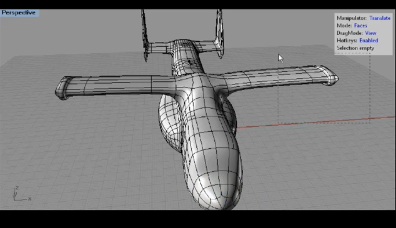
T-Splines 2.0 Nearly Available

 
T-Splines 2.0 for the Rhino 3D modeling package is apparently going to ship in the next few weeks, and we noted some very useful features:
  • Maintains a continously editable smooth and watertight model - watertightness is not lost during editing
  • Organic shapes are easily and quickly created
  • Ability to define high or low detail areas
  • Ability to define non-rectangular areas
  • Rapid editing techniques
  • Ability to export watertight models directly to manufacturing without remodeling
  • Fully integrated into Rhino

If you're into Rhino, you might want to check that one out.

Via Rhino News

Reader Comments (2)

I hadn't heard about NURBS in ages-- T-Splines are an interesting compromise, although I think subdivision modeling can *usually* take over for this one.

Anyone know where and why this beats subdivision modeling? I'm guessing it's got to do with manifold-ness but I can't think of any situations where stretching a skin over splines is better than a subdivided mesh made of all quads.

May 15, 2009 | Unregistered CommenterThe Masked Retriever

@TMR:
As spline curves are usually more accurate, they are used heavily in solid modeling of real objects.

May 15, 2009 | Unregistered CommenterSam

PostPost a New Comment

Enter your information below to add a new comment.

My response is on my own website »
Author Email (optional):
Author URL (optional):
Post:
 
Some HTML allowed: <a href="" title=""> <abbr title=""> <acronym title=""> <b> <blockquote cite=""> <code> <em> <i> <strike> <strong>