
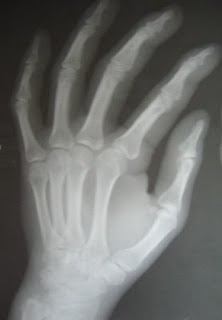
New Scientist reports on a medical breakthrough using 3D printing: exact replicas of finger bones have been produced. Christian Weinand of Berne Switzerland has been testing a new technique in which a 3D model of a finger bone is fed into a 3D printer, and an exact duplicate is printed. By using a suitable print medium (in this case “tricalcium phosphate and a type of polylactic acid – natural structural materials found in the human body”) the resulting artificial bone can be inserted into the body and take over for the failed bone. Weinand says:
In theory, you could do any bone. Now I can put spares in my pocket if I want.
You’re probably wondering exactly how you get a 3D model of a bone that requires replacement. If it’s being replaced, presumably it’s severely damaged, or even missing. The answer is straightforward – simply scan a model from its counterpart on the opposite hand! Obviously, this approach has some limitations, as there are singularly appearing bones, and what if both sides were damaged?
Via New Scientist
![Reblog this post [with Zemanta]](http://img.zemanta.com/reblog_e.png?x-id=9f6775a6-7248-47de-8850-cbf50984174d)

Re: the question about how to get the models of bones that have been damaged or lost.
The answer is to back up your bones. Include a CT scan in your yearly medical checkup, compute 3d models from the data, put it on your thumb drive (har har) and keep *that* in your pocket.
http://blog.makezine.com/archive/2009/03/animation_from_ct_scan_images.html?CMP=OTC-0D6B48984890“ REL=”nofollow”>Here is a project where the images from a standard CT scan were stitched together into a movie, the data looks pretty clean. It looks like the 3d models would be pretty easy to extract.