
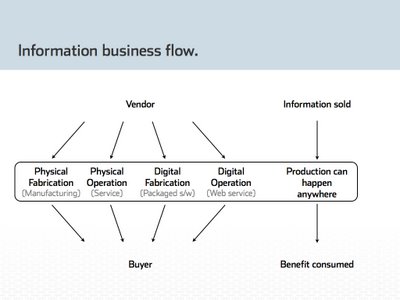
We just finished reading a fascinating 3-part post on Zeus Jones that resonated with many of the concepts we’ve been pondering. Fabbaloo readers will recall that our vision of the future includes a world where most people have desktop manufacturing equipment in their homes, and “shopping” for some, perhaps many objects is done by selecting a design from a repository (or by paying a service) and then producing the object on the home printer.
There’s many implications of such a scenario to society, but Zeus Jones has captured one rather interesting notion: in that world, the information becomes the focus, not the objects. Consider that printed objects may break, disappear or become obsolete, while the associated 3D design remains forever in a repository. This leads to the fantastic idea that:
physical forms may actually be the temporary states for information, while digital forms may actually be the permanent states
Zeus Jones goes on to suggest several potential consequences of this paradigm:
- Products and services give physical form to information
- Information will be more valuable than objects
- There may be two classes of objects: those you can print yourself and those others must print for you
- Products are temporary and throw away
- Product design becomes information design
It’s a different way of thinking about objects and information. We suspect that this paradigm is actually emerging today in the minds of designers worldwide, as their focus increasingly lies on models, and less on the resulting objects. Do you agree?
Via From The Head Of Zeus Jones, Part 1, Part 2, Part 3

This is a great insight. Look at nature, genes contain the design information and are carried through generations leaving a rubbish heap of biological form to carbonize. The world of products is just the same.
Information rules !