
Sponsors

Recommended
  • Rule 34
    Rule 34
    by Charles Stross

    Stross delves into a possible future where 3D printers become commonplace - and explores the problems that could result. 

  • Printing in Plastic: Build Your Own 3D Printer (Technology in Action)
    Printing in Plastic: Build Your Own 3D Printer (Technology in Action)
    by James Floyd Kelly, Patrick Hood-Daniel
  • 3Dconnexion SpaceNavigator SE (Standard Edition) 3D Navigation Device USB ( 3DX-700028 )
    3Dconnexion SpaceNavigator SE (Standard Edition) 3D Navigation Device USB ( 3DX-700028 )
    3D Connexion
  • The Homebrew Industrial Revolution: A Low-Overhead Manifesto
    The Homebrew Industrial Revolution: A Low-Overhead Manifesto
    by Kevin A. Carson
  • Mastering Blender
    Mastering Blender
    by Tony Mullen
  • Kindle Wireless Reading Device (6
    Kindle Wireless Reading Device (6" Display, Global Wireless, Latest Generation)
    Amazon.com
  • Blender 3D 2.49 Incredible Machines
    Blender 3D 2.49 Incredible Machines
    by Allan Brito
  • Makers
    Makers
    by Cory Doctorow
  • 3Dconnexion SpacePilot PRO - 3D motion controller - 31 button(s) - wired - USB
    3Dconnexion SpacePilot PRO - 3D motion controller - 31 button(s) - wired - USB
    3D Connexion
« Home Printing? Home-Based Printing? | Main | Open Manufacturing »
Thursday
Feb122009

Architectural Concepts via 3D


Readers may notice our occasional rant on how 3D tech is often used to produce common objects, simple things that are merely more conveniently produced than traditional approaches. But that's not what gets our gears turning. We look for entirely new concepts, things that would not have existed if not for the exploitation of contemporary 3D capabilities.

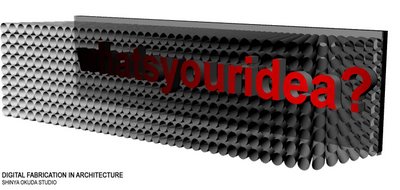
Once such example is found at the Shinya OKUDA Studio, who recently posted a series of 3D architectural explorations.

As you peruse their fascinating explorations, you begin to get a feeling of freedom. Freedom from the normal constraints of design elements and an ability to make anything you can imagine. And then, they print it.

Conclusion: 3D modeling and printing can amplify imaginations and things develop that would otherwise never happen.

In their study we particularly liked the idea of a "Directional Translucency" sign that would reveal the message only when the viewer is at a specific position.

Sure, it's not a life-size building. But it could be.

Via Digital Fabrication in Architecture

Reader Comments

There are no comments for this journal entry. To create a new comment, use the form below.

PostPost a New Comment

Enter your information below to add a new comment.

My response is on my own website »
Author Email (optional):
Author URL (optional):
Post:
 
Some HTML allowed: <a href="" title=""> <abbr title=""> <acronym title=""> <b> <blockquote cite=""> <code> <em> <i> <strike> <strong>