
Sponsors

Recommended
  • 3Dconnexion SpaceNavigator SE (Standard Edition) 3D Navigation Device USB ( 3DX-700028 )
    3Dconnexion SpaceNavigator SE (Standard Edition) 3D Navigation Device USB ( 3DX-700028 )
    3D Connexion
  • The Homebrew Industrial Revolution: A Low-Overhead Manifesto
    The Homebrew Industrial Revolution: A Low-Overhead Manifesto
    by Kevin A. Carson
  • Mastering Blender
    Mastering Blender
    by Tony Mullen
  • Kindle Wireless Reading Device (6
    Kindle Wireless Reading Device (6" Display, Global Wireless, Latest Generation)
    Amazon.com
  • Blender 3D 2.49 Incredible Machines
    Blender 3D 2.49 Incredible Machines
    by Allan Brito
  • Makers
    Makers
    by Cory Doctorow
  • 3Dconnexion SpacePilot PRO - 3D motion controller - 31 button(s) - wired - USB
    3Dconnexion SpacePilot PRO - 3D motion controller - 31 button(s) - wired - USB
    3D Connexion
  • Making it Big in Software: Get the Job. Work the Org. Become Great.
    Making it Big in Software: Get the Job. Work the Org. Become Great.
    by Sam Lightstone
« Replacing .STL | Main | The Demise of FedEx? »
Thursday
Nov192009

Real-Time 3D Scanning - With a WebCam!


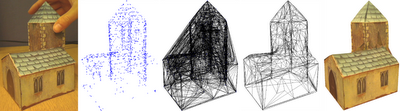
Researchers at the University of Cambridge have developed a breakthrough technique for vastly simplified 3D scanning. The system, called ProFORMA (Probabilistic Feature-based On-line Rapid Model Acquisition) uses 3D Delaunay tetrahedralisation to transform scanned points into a 3D surface mesh in real time by merely hand-turning an object in front of a webcam!

The video demonstrates the startling potential of this software, which theoretically could run on virtually any home computer. 
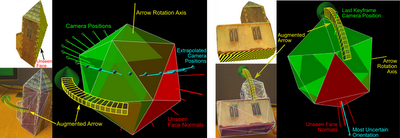


According to their paper:

ProFORMA uses a fixed video camera to allow on-line reconstruction of objects held in a user's hand. Partial models are generated very quickly and displayed instantly, allowing the user to plan how to manipulate the object's pose in order to generate additional views for reconstruction. We demonstrate how augmented reality can be used to assist the user in view planning, guiding the user to collect new keyframes from desirable views in order to complete and refine the model.


We'd like this rapid scan technique to eventually become a standard feature for home computers, as that would massively simplify some of the difficulties in consumer use of 3D systems.

Via Cambridge University Engineering Department and PhysOrg (Hat tip to Micah)

Reader Comments

There are no comments for this journal entry. To create a new comment, use the form below.

PostPost a New Comment

Enter your information below to add a new comment.

My response is on my own website »
Author Email (optional):
Author URL (optional):
Post:
 
Some HTML allowed: <a href="" title=""> <abbr title=""> <acronym title=""> <b> <blockquote cite=""> <code> <em> <i> <strike> <strong>