
Sponsors

Recommended
  • 3Dconnexion SpaceNavigator SE (Standard Edition) 3D Navigation Device USB ( 3DX-700028 )
    3Dconnexion SpaceNavigator SE (Standard Edition) 3D Navigation Device USB ( 3DX-700028 )
    3D Connexion
  • The Homebrew Industrial Revolution: A Low-Overhead Manifesto
    The Homebrew Industrial Revolution: A Low-Overhead Manifesto
    by Kevin A. Carson
  • Mastering Blender
    Mastering Blender
    by Tony Mullen
  • Kindle Wireless Reading Device (6
    Kindle Wireless Reading Device (6" Display, Global Wireless, Latest Generation)
    Amazon.com
  • Blender 3D 2.49 Incredible Machines
    Blender 3D 2.49 Incredible Machines
    by Allan Brito
  • Makers
    Makers
    by Cory Doctorow
  • 3Dconnexion SpacePilot PRO - 3D motion controller - 31 button(s) - wired - USB
    3Dconnexion SpacePilot PRO - 3D motion controller - 31 button(s) - wired - USB
    3D Connexion
  • Making it Big in Software: Get the Job. Work the Org. Become Great.
    Making it Big in Software: Get the Job. Work the Org. Become Great.
    by Sam Lightstone
« Can We Paddle into 3D? | Main | Lego Polar 3D Printer »
Monday
Sep012008

Programmable Matter

Ok, this is it - 3D Printing is obsolete! No, we're just kidding. But it could come to pass eventually if the predictions of Intel CTO Justin Rattner come true.

ZDNET reports on his keynote address at the Intel Developer Forum, in which he discussed a concept called, "Programmable Matter":

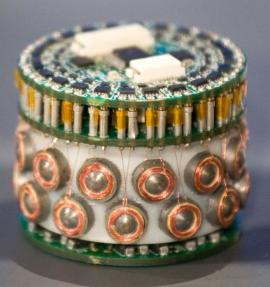
The idea of programmable matter, he explained, revolves around tiny glass spheres with processing power and photovoltaic for generating electricity to run the tiny circuitry. These particles called catoms would move relative to one another via electrostatic.

The concept of programmable matter can be thought of as "the ultimate form of digital printing", Rattner told ZDNet Asia Wednesday in an interview. "You literally could make an object of any imaginable shape, or design an object of any imaginable shape, and simply 'hit the print command' and the matter would take that shape.


While this seems far fetched, Intel engineers have apparently already produced prototype "catoms" that are presently large-sized. Over time, we're pretty sure they'll be able to shrink these down as Intel has a teeny bit of experience in making very small things. And shrinking the device is not the only thing they'll have to figure out.

Via ZDNET

Reader Comments

There are no comments for this journal entry. To create a new comment, use the form below.

PostPost a New Comment

Enter your information below to add a new comment.

My response is on my own website »
Author Email (optional):
Author URL (optional):
Post:
 
Some HTML allowed: <a href="" title=""> <abbr title=""> <acronym title=""> <b> <blockquote cite=""> <code> <em> <i> <strike> <strong>
