
Sponsors


Recommended
  • Rule 34
    Rule 34
    by Charles Stross

    Stross delves into a possible future where 3D printers become commonplace - and explores the problems that could result. 

  • Printing in Plastic: Build Your Own 3D Printer (Technology in Action)
    Printing in Plastic: Build Your Own 3D Printer (Technology in Action)
    by James Floyd Kelly, Patrick Hood-Daniel
  • 3Dconnexion SpaceNavigator SE (Standard Edition) 3D Navigation Device USB ( 3DX-700028 )
    3Dconnexion SpaceNavigator SE (Standard Edition) 3D Navigation Device USB ( 3DX-700028 )
    3D Connexion
  • The Homebrew Industrial Revolution: A Low-Overhead Manifesto
    The Homebrew Industrial Revolution: A Low-Overhead Manifesto
    by Kevin A. Carson
  • Mastering Blender
    Mastering Blender
    by Tony Mullen
  • Kindle Wireless Reading Device (6
    Kindle Wireless Reading Device (6" Display, Global Wireless, Latest Generation)
    Amazon.com
  • Blender 3D 2.49 Incredible Machines
    Blender 3D 2.49 Incredible Machines
    by Allan Brito
  • Makers
    Makers
    by Cory Doctorow
  • 3Dconnexion SpacePilot PRO - 3D motion controller - 31 button(s) - wired - USB
    3Dconnexion SpacePilot PRO - 3D motion controller - 31 button(s) - wired - USB
    3D Connexion
« Where's Your Face? | Main | Easton Predicts A Consumer Manufacturing Future »
Friday
Dec262008

40,000 Lights are Better Than One


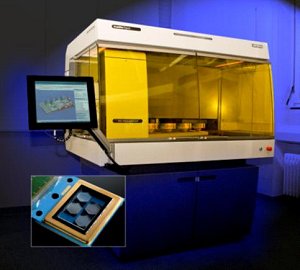
That's the claim made by Huntsman Advanced Materials, who recently announced the availability of their new Araldite Digitalis. It's a stereolithography machine that produces 3D objects by selectively hardening pixel-sized areas of a resin.

Most stereolithography machines utilize a laser to gradually "draw" each layer of pixels into the media resin. Huntsman Advanced Materials has a very unique approach to the hardening process, which typically is the most time-consuming part of the process. Instead of a single laser tracing the pattern, they use MEMS (micro-electromechanical systems) to produce 40,000 light pixels simultaneously! According to their website, the approach "significantly reduces production times and thereby costs".

We're fascinated by this development, as it is quite a break from most "single pixel" 3D printing techniques. Unfortunately, no statistics were immediately available from Huntsman, so we can't say precisely how much faster this technique might be. However, we can all imagine the possibilities here: solving the biggest issue in 3D printing today, time to print. Currently it takes hours to produce even the smallest items, and often several runs are required to produce all component pieces for later assembly. With the "parallel pixel" approach build times are sure to drop significantly.

Can other printer manufacturers develop similar approaches with their technology? Will this tech eventually make its way into home-based fabbers, and permit quick builds? Time will tell.

Via Huntsman and Develop3D

Reader Comments (1)

How is this different from the perfactory? It uses DLP...also known as micromechanical mirrors to harden the material.

October 28, 2011 | Unregistered Commenterchris norman

PostPost a New Comment

Enter your information below to add a new comment.

My response is on my own website »
Author Email (optional):
Author URL (optional):
Post:
 
Some HTML allowed: <a href="" title=""> <abbr title=""> <acronym title=""> <b> <blockquote cite=""> <code> <em> <i> <strike> <strong>